Sunday, July 12, 2020
Southern Hymns--The Southern Joy Quartet, The Thomas Family (Royale 18121)
A budget Sunday afternoon gospel, from a ten-inch Royale reissue of sides recorded in 1946 for Majestic. I got decent sound out of this cheap piece of wafer-thin vinyl, but only because I used my widest LP needle--a conventional .07 mil needle doesn't do the job. Excellent, traditional Southern gospel material, with the numbers by the Thomas Family (a Chuck Wagon Gang-style group) especially bouncy, save for the slow-gospel standard, Farther Along, which quick on-line research reveals to have words and music by William B. Stevens, from 1911 (the words, at least).
I Ain't Gonna Study War No More is, of course, is a spiritual also known as Down By the Riverside.
The Southern Joy Quartet is a very solid group--kind of a less showy Statesmen Quartet. Nice to find gospel of this high quality from the least of the cheap label groups. This was a last-minute job, as I'd put a lot of work into restoring a more recent (1968) black gospel LP that I should have Amazon-checked right off the bat. A common sense lapse, since the artist was super-popular. The album took a lot of work, and it was only until I had it almost ready to go that I checked Amazon and, of course, found it in digital-download form. I was initially so happy to have thrifted such fine material, I didn't stop to think. Of course, not thinking is an American tradition, so perhaps I was simply fulfilling my patriotic duty.
Luckily, today's LP gave me little trouble, ripping-wise, and it turns out to be excellent. Can't complain. For both groups, these tracks appear to be their entire Majestic/Eli Oberstein output. I kind of like the minimalist art on these ten-inch Royales, art which is credited, in this case, to "Design House," which I doubt is the artist's name. But you never know. ("Hey, Design! Mr. House! We need same art. Are you free this afternoon?")
DOWNLOAD: Southern Joy Quartet, Thomas Family
I'm a Debtor, I Know--The Southern Joy Quartet (1946)
My Labor Will Be O'er--Same
There's a Little Log Cabin--Same
He Set Me Free--Same
I Ain't Gonna Study War No More--The Thomas Family (1946)
Farther Along--Same
I Can't Sit Down--Same
You Better Get Down on Your Knees and Pray--Same
Southern Hymns (Royale 18121, 10" LP)
lee
Saturday, July 11, 2020
Rock Around the Clock-athon--fake-hit versions, and more!
(We're Gonna) Rock Around the Clock was copyrighted in 1953 and recorded by Bill Haley in 1954 as the B side of Thirteen Women. It was done in two takes at the end of the session, and the version we know is a combination of those two takes (Haley's voice was allegedly drowned out by the band on the first one). I won't go into the authorship issues, as they are complicated, and I keep forgetting the exact details. What we mainly need to know is that Bill Haley made significant changes to the song as written. Oh, and we need to know that RATC (my abbreviation from this point on) was only modestly successful when first released--as in, not a hit. It became a huge hit the following year, when it was used in the soundtrack of the movie Blackboard Jungle. Kind of ironically, RATC had a second (third?) life in 1974, when it was used as the theme music for Happy Days.
Sonny Dae and His Knights made the first recording of RATC in 1953 or 1954 (which of the two years is apparently unknown). It seems to be a tradition to regard Dae's (Paschall Salvatore Vennitti) as lacking in every regard (to emphasize the greatness of Haley's version, I reckon), but I personally dig it--it genuinely rocks, and in an authentic R&B manner, even though the musicians were white, and the guitar solo is excellent. Problem with the guitar-solo part is that Danny Cedrone's incredible twelve-bar break on Haley's record blows just about every other rock and roll guitar solo ever recorded off the face of the planet, so nearly any competing RATC guitar solo is going to suck by comparison. As many of you already know, Cedrone RATC solos was a repeat of his 1952 guitar solo for Bill Haley's recording of Rock the Joint. With the recording session nearing its end, he had no time to come up with a fresh solo, luckily for everyone.
Not so lucky was Cedrone's death from a fall ten days after he did his famous RATC solo. He died from a broken neck and of course never learned that he'd played a major role in a record some folks regard as THE rock and roll record of all time. (I'm fine with that, personally. I don't think there's literally a best-ever r&r record, but if there was, RATC is a prime candidate.) Franny Breecher, Haley's regular lead guitarist from 1954 to 1962, wasn't able to replicate Cedrone's downward chromatic slide on the RATC guitar break, so he played a modified version. Knowing this, it's amusing to see Breecher and the rest of the band mime to the original recording on early TV appearances.
Author Jim Dawson wrote a book on RATC, and it has lots of vital info, but--and there's no nice way of saying this--Dawson's musical analysis is gibberish. To wit, when Haley goes from A to C-sharp to E at the start of RATC, he is not modulating--he's singing an A Major triad in root position. No modulating is happening. And "F-minor" is a key, not a note. Et cetera The structure of RATC (in its published form) is simple: 1) a four-bar vamp, 2) an eight-bar verse in minor mode (F minor), then 3) the conventional twelve-bar blues in, well, twelve bars. The song has no release/bridge. Maybe the best example of a twelve-bar blues song with a release is Harold Arlen's Blues in the Night.
It seems that everyone, including Sonny Dae, took liberties with the song's melody and rhythms. Dae reduced the eight-bar verse to two chords (I and V), and he starts the melody on the mediant (third note of the scale) instead of the tonic. Haley went several steps further, changing the verse to a climb up the tonic triad, prior to changing the melody to 1-3-5 instead of 1-2-3, in terms of scale degrees. As written, the song lends itself to a big band-ish treatment, and some of today's versions are just that, so we'll get to hear what the song would have sounded like during the reign of Glenn Miller.
I have 38 tracks for you, so no one can call me stingy. Well, actually, anyone can, but it would be debatable in this case, I think. The first group consists of 18 tracks, because I thought I only had 37 tracks, overall, but then I found a straggler. Long story. Some of the scanned images may not be the specific editions I'm featuring, but they're the same versions. We all know by now how the budget labels worked--when they weren't re-releasing their own stuff, they were sharing tracks across different label groups.
Most of these versions follow from Haley's recording (and, in fact, the EP 4 Hits single is actually the Haley recording pirated, with a DJ-style voiceover!), but a small number (mostly) follow the song as originally written. These as-written versions are The Living Guitars, Bill Coates, Artie Malvin, Adam Nowicki's polka version (believe it or not), Al Caiola (Tuff Guitar), the dance-class version on the Artti label (though it omits the verse), J. Lawrence Cook's piano-roll version, and the MGM Studio Orchestra. I'm assuming that, whenever we hear the number as written, the artists are following the published music. In some cases, the artists may even have been unfamiliar with the Haley performance (it's possible).
Then there are the quirky versions. Or maybe I should modify that to "especially quirky." For instance, there's the dance-class Statler label 45, on which the singer seems to be totally new to the melody, which she messes up pretty memorably. And, not to be mean, but there's the Smoky Mountain Rangers ("Vaselino" is a stage name, but for which member, I don't know)--this has a mistimed opening and ending, and just general confusion throughout. The steel orchestra version would be quite interesting in any event, even if it were less than well done, but it's in fact spectacular. One step from mind-blowing. AMRAL, btw, is a travel agency.
The comedy versions come courtesy of the late, brilliant Buddy Hackett, with his highly un-PC but (I apologize) hilarious Chinese Rock and Egg Roll, from 1956, and ripped from a ten-inch various-artists LP in my collection. And from master musical parodist Stan Freberg, who famously despised rock and roll. I've been told that many young rock and roll fans dug the rock hits and Stan's take-down of them, which is incredibly cool.
There are some dupes--Gabe Drake shows up, uncredited, on both the Peter Pan label (from which I rescued a fake-stereo reissue) and the Popular Extended Play Records label, but I thought it would be fun to share both. I don't know why. And, to include an example of label-hopping, we have the lousy version credited to both Dick Warren on Big 4 Hits (and Gateway Top Tunes) and Fred Gibson on Tops. Of the contemporary fake versions, I've always preferred Drake's, but the Jack Richards version of Broadway does have the benefit of a guitarist who actually nails Danny Cedrone's solo, so.... Oh, and it's the Jack Richards version which is credited to the Royale Dance Orch. on Royale. The label probably used some "famous artists from stage and TV"-type addition, too, but I failed to include it. It's Jack Richards--that's all we need to know.
Unfortunately, the Myron Floren RATC isn't an accordion version. I'd love to have heard what that amazing musician would have done with the song. Likely, dazzle the listener. But it's a big band version, and that's okay, because it's quite well done. And you always wanted a version by the Candy-Rock Generation, whether or not you're willing to admit it. To the, um... clock! If there's any time left after this epic essay.
DOWNLOAD: RATC 1 RATC 2, plus images
RATC 1
The Living Guitars (Al Caiola) (Rock 'n' Roll with... LP, RCA; 1970)
Bill Coates at the Console (Maple Records 101, 45 rpm)
Artie Malvin (Themes from Hollywood Films, LP, Audition 33-5911)
Jack Richards w. Vic Corwin and His Orch. (Broadway 301, 45 rpm)
No Artist Credit (but it's Gabe Drake, of Prom) (Popular Extended Play Records, 78 rpm EP)
Dick Warren w. the Glenn Horne Sextet (Big 4 Hits 144, 45 rpm; 1955)
The Four Bells, Jimmy Carroll and His Orch. (Bell 1098, 45 rpm; 1955)
Pat Boone (Pat, Dot DLP-3050, LP; 1957)
The Chevrons (Sing-a-Long 26 Rock and Roll Hits, LP, Chevron; 1961)
Tommy Oliver and His Orch. (The Rockin' '50s, LP, Warner Bros.; 1958)
Phil Flowers (Kasey 7006, 45; 1964)
MGM Studio Orchestra, c. by Charles Wolcott (MGM K12028, 45 rpm; 1955)
Unknown Artist (Artti 104, compact 33 1/3 rpm)
Adam Nowicki and His Polka Band (Polkas from Pennsylvania and the Delaware Valley, LP, Request Records)
Smoky Mountain Rangers, voc: Vaselino (LP, no label name)
Unknown Artist (EP 4 Hits, 45 rpm)
Stan Freberg--Rock Around Stephen Foster (From LP, 1955)
Myron Floren and His Orchestra (22 Dance Party Favorites, LP, Ranwood; 1982)
RATC 2
Al Caiola (Tuff Guitar, LP, United Artists, 1964)
J. Lawrence Cook (piano roll version!) (Piano Roll Rock n' Roll, LP, Mercury, 1959)
Manolo Munoz (gas G-084, 45 rpm; 1974)
Chubby Checker (Your Twist Party, LP, Parkway; 1961)
Ray Martin, Conductor (Pop Goes the Swingin' Marching Band, LP, RCA; 1958)
Papa Joe's Music Box (Same, Ranwood, 1974)
Waterford High School Wildcat Marching Band (Coronet Recording Company, 45 rpm; 1965)
Dick Parker (Stepping Tones 504, 7-inch 33/13)
The Evans Sisters w. the Sherwin Linton R&R Revival Band (Black Gold Records 7561, 45 rpm)
Frankie Carle (Era: The 50s, Dot DLP 25928; 1973)
The Candy-Rock Generation (Super Rock, boxed LP set, Columbia Music Treasury, 1969)
Gabe Drake w. the Prom Orch., Dir. Maury Laws (The Mickey Mouse March, LP, Peter Pan Records)
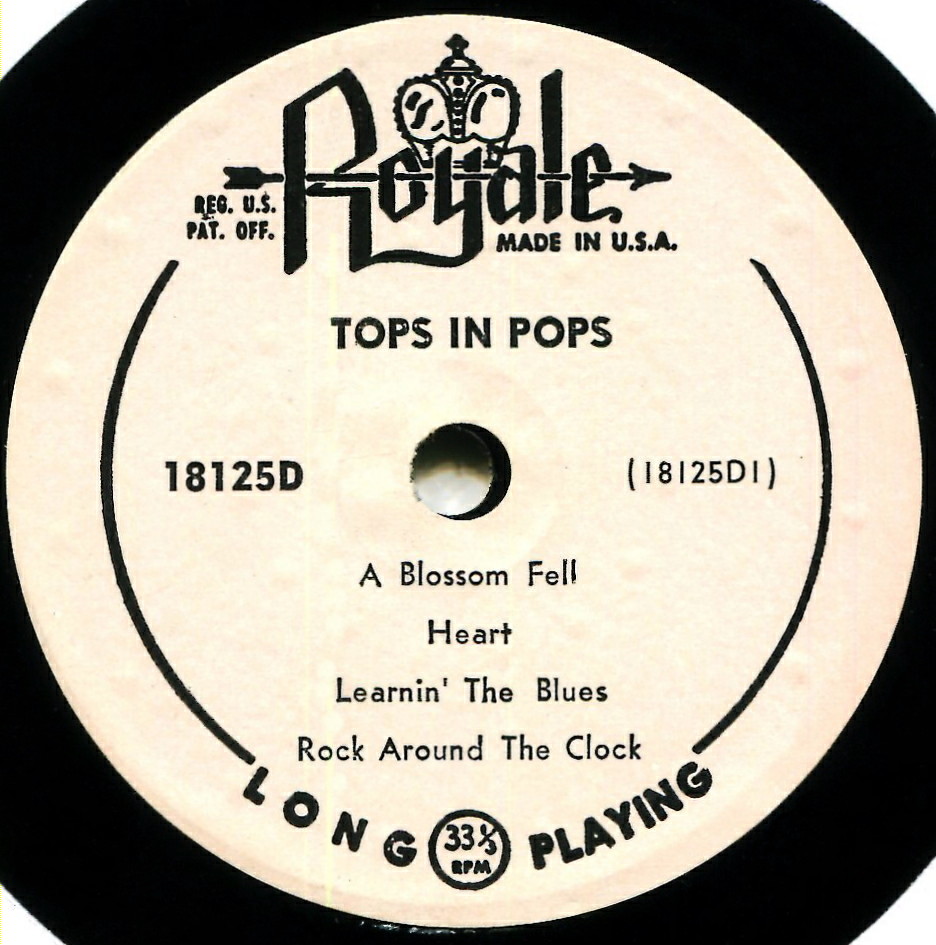
Royale Dance Orch. (Tops in Pops, LP, Royale 18125E)
Unknown Artist (Statler Record 933, 45 rpm)
Fred Gibson w. the Bill Allen Orch. (Tops 45-R258-49, 45rpm)
The Sound Effects (Summer '74. LP, QMO Records)
Buddy Hackett--Chinese Rock and Egg Roll (Hackett) (Fun Time, LP, Coral)
Donna Parker, Wurlitzer Theatre Pipe Organ (Then and Now, LP)
Ray Anthony and His Bookends--Twist and Rock Around the Clock (The Twist, LP, Capitol; 1962)
AMRAL's Trinidad Cavaliers Steel Orch. (Steel Vibrations, LP, 1973)
Lee
Thursday, July 09, 2020
Another Parade of Hits A' Poppin (Parade 5004; prob. 1954)
This is the second of the my Parade of Hits a Poppin' ten-inch LPs, with Earl Sheldon and "Stars of Radio and Television" (did that phrase originate here?) getting all the credit this time. Actually, Sheldon appears on only half of the numbers--the other four are backed by Enoch Light. The vocalists, not credited, are Loren Becker, Artie Malvin, Laurie Leslie, and Jerry Packer. And this is the same "Alessandro" artwork as last time, only with a red background. The more I study the cool period art, the stranger it seems. Study those circles.
Eight "full length HITS," and they're excellent fakes, as before. Not always, but typically Enoch Light's labels offered high quality tracks with better fidelity than that of other rack jobber labels (e.g., Tops, Music Masters, and the Synthetic Plastics Co. herd). Both Sides Now reports that Enoch started Waldorf Music Hall (home of 18 Top Hits, Waldrof Record Corp., and Top Hit Tunes) in 1953 or 1954, and I'm thinking it had to be 1954, as this is when he appears to have parted company with Parade and Prom. (This stuff gets complicated.) Prom became a Synthetic Plastics Co. label, and Parade... Well, I'm not sure about Parade. I'm also not sure about Discog's designation of "Hits A' Poppin'" as a label, which I don't think it was--it was a series, and I'm nearly certain SPC took it over post-Enoch Light. But my brain has reached its cheap-label-information storage limit, and a recorded voice is telling me to "Turn back! Turn back!" It's best to obey, because these details get epic. When it comes to keeping track of who did what, the chief problem is the budget-label tradition of hiding company info (as if these guys were engaged in some kind of tax dodge, which I wouldn't rule out as a possibility). I even have some early 1960s fake-hits singles on which no label name of any kind is offered. (For all I know, they came from a fake-hits vending machine.) And the various series names--"Parade of Hits," "Top Hits," "Tops in Pops"--were generic. Even the Cadence and Capitol labels had a "Tops Hits" series, which featured the labels' artists covering the latest hits--Mercury and Columbia used its pop singers in the same fashion. Small world.
Everyone, from the cheapest of the chepies to the big labels, was guilty of trying to wring every last penny from every last hit, and it's almost as if... as if the music biz was a for-profit industry. One does get that impression. Hm. I thought it was a charity.
Anyway, not a bad track in today's bunch, and I especially like the spirited Cross Over the Bridge version, which anyone would have known was a copy of Patti Page, even if that person lived in a culture in which Patti Page had never been introduced. ("It is Patti Page. I don't know who she is, but somehow I know this is an imitation of her. She sounds something like our big star, Zardee Mlekksoros.") The Darktown Strutters' Ball is a very good copy of Lou "Pepino the Italian Mouse" Monte's hit version, and this incredibly catchy and famous number goes back to 1917, a year when words like "blacktown" were just part of the pop vocabulary. It's one of those numbers that became so familiar and so often performed that its racist nature became an overlooked thing, I guess. Not sure how it would go down nowadays. And while There'll Be No Teardrops Tonight is a Hank Williams classic, we're not hearing a cover of Hank here--it's Tony Bennett's hit pop version being copied. And Artie Malvin had a very different voice than Tony Bennett (and vice versa), but he does an adequate cover. I think both singers were a bit at sea with this kind of material, but the jazzy arrangement works for me. I just love this period of pop, even though it predates me. I grew up with the Beatles, Beach Boys, then the horrors of 1970s Top 40, but I feel more at home in the period just before Elvis. Maybe I was reincarnated. I don't believe in such stuff, but who knows?
Quality fakes on cheap vinyl (the kind of rock-hard plastic that feels like shellac), with incredibly cool cheap packaging. I think I coaxed some good sound out of this early rack-jobber relic. Enjoy!
DOWNLOAD: Parade of Hits A'Poppin' (Parade 5004; prob. 1954)
A Girl, A Girl (Zoom-Ba, Di Alli Nella) (Benjamin-Weiss-Bandini)--Loren Becker w. Earl Sheldon's Orch. and Chorus
Amenra E Core (Manlio-Curtis-d'Esposito-Akst)--Same
Cross Over the Bridge (Benjamin-Weiss)--Laurie Leslie w. Earl Sheldon's Orch.
Melancholy Me (Thomas-Biggs)--Jerry Packer w. Earl Sheldon's Orch. and the Packers
The Darktown Strutters' Ball (Shelton Brooks)--Artie Malvin w. the Light Brigade
There'll Be No Teardrops Tonight (Hank Williams)--Same
Wanted (J. Fulton-L. Steele)--Loren Becker w. Enoch Light Orch. and Chorus
Young at Heart (J. Richards-C. Leigh)--Same
Parade of Hits A' Poppin' (Parade 5004; prob. 1954)
Lee
Tuesday, July 07, 2020
Parade of Hits a' Poppin'--Loren Becker, Artie Malvin, more (prob. 1954)
"Fine records needn't be expensive"--Back jacket. Now we know where Synthetic Plastics Co. got this logo. Anyway, I love Discogs, but they goofed with this series and with this LP. They gave this a year of 1951, which can't be, since the Eddie Fisher hit Oh, My Papa was recorded in December, 1953 and hit the charts in 1954. Also, Discogs calls "Hit A' Poppin" a sublabel of Parade, which would only have been the case had the words "Hits A' Poppin'" been used as the label name, and "Parade" is quite clearly displayed on the jacket and label. Or, Parade Reocrds. Take your pick. And the full series title, which I hand't noticed until today, was actually "Parade of Hits A' Poppin'"--so, as ever, life in the cheap-label lane is more complicated than many would think. Anyway, I'm giving this LP a date of 1954. There was some light mildew on the hard-cardboard jacket, but I cloned it out, so you won't even know it was there. Unless I tell you. (D'oh!!)
This is a request from Eric, and I hope he enjoys it--that goes for everyone else, too. These are really quite well done, which is likely because this was an Enoch Light label (at the time). Sound is acceptable. I used my 1.0 mil stylus and some light hiss filtering. Had to cut out a few pops. The usual. Get a few prints, then book 'em. Wait--wrong show.
These eight "full length HITS" are credited to Enoch Light and his Orchestra, featuring "The Light Brigade." I guess I always thought the "Brigade" was his orchestra, and not a subsection thereof, but who knows. Enoch started his band-leading days in the 1920s, and for a long time, that's where I knew him from. So I was initially surprised to see his name popping up on these things--ditto for Vincent Lopez. Anyway, checking the Prom label discography to find out who's singing on these (no singer credits on the LP), I discovered that Light is only present on two tracks. Orchestra-wise, the rest feature Bobby Byrne and Vincent Lopez. Singers Loren Becker and Artie Malvin have two tracks apiece, and there's one each for Betty Green, The Brigadiers Quartet, The Four Brigadiers, and virtuoso trumpeter "Red" Solomon. And... wouldn't the Brigadiers Quartet and the Four Brigadiers be the same singing group?
Oh, and the jacket says Oh, My Papa, but the label says Mein. I did not einen Fehler machen. And I used the full title for the last track, as printed on the original label (Prom 1068)--The Gang That Sang "Heart of My Heart." It was shortened for this LP. Full length HITS but half-titles. I'm shocked!
So... eight highly competent early-period fake hits, with more to come, and with a long Rock Around the Clock post coming up. Still working on that one. Enjoy!
DOWNLOAD--Parade of Hits A' Poppin' (Parade Records 5002, prob. 1954)
Stranger in Paradise (Wright-Forrest)--Loren Becker w. Enoch Light Orch.
To Be Alone (Billy Vaughn)--Artie Malvin w. Vincent Lopez Orch.
That's Amore (J. Brooks-H. Warren)--Artie Malvin w. Bobby Byrne Orch.
Why Does It Have to Be Me (C. Sigman-P. Faith)--Loren Becker w. Bobby Byrne Orch.
Oh, Mein Papa (Burkhart)--"Red" Solomon, Trumpet Virtuoso, Acc. by Bobby Byrne Orch.
Changing Partners (M. Coleman-J. Darion)--Betty Green w. Bobby Byrne Orch.
Love Walked In (George and Ira Gershwin)--The Brigadiers Quartet
The Gang That Sang "Heart of My Heart" (Ben Ryan)--The Four Brigadiers w. Enoch Light Orch.
Lee
Friday, July 03, 2020
Yes, major labels put out fake-hits LPs: The RCA Camden Rockers, 1959
In case anyone has been dying to know whether or not major (and legit minor) labels did fake-hits LPs... well, now you know. Here's an RCA budget LP of hit copies, all performed by "The RCA Camden Rockers." I wonder if they were "Stars of Radio, TV, Stage and Screen" working under another name. Or, possibly, the famous budget outfit known as "Vocals and Orchestra by Popular Artists." The RCA Camden Rockers. Bet RCA dreamed that one up on the spot. "How about the 'RCA Camden Rockers'?" "Why not? This is just a budget issue, so... sure. Whatever."
I like the bit of the three teenage girls listening to The Great Artie Shaw on (surprise!) the RCA Camden label. It's the one lying on the floor, to the left of the sleeveless LP. (Record jackets never showed people handling records properly...) Of course, a junk label wouldn't have pushed the jacket photo toward the bottom, as here. Anywhere, here's the LP they're inexplicably grooving to:
I can't identify the other three jackets (there's an album leaning up against the girl in pajamas). RCA has taken a type of scene common to cheap-label issues, only with some "cheesecake" added. The gal on the hammock-style chair is saying, "We're on the cover of The Biggest Hits of '59, and we're listening to Artie Shaw?" And those haircuts...
So, you might figure that these RCA (Camden) fake hits are bound to be a notch or two above the junk-label product, and you would be... wrong. The opening fake, Venus, sounds like the one put out by Synthetic Plastics Company (SPC), featured in this post. As in, the very same track. When I have a moment to do track comparisons, I imagine I'll find some other numbers lifted (legally, I'm sure) from the junk labels. This all confirms my feeling that RCA never put tons of pride into its budget line. That didn't prevent a lot of great stuff from coming out on RCA Camden, but RCA clearly didn't give a hoot on a release of this type.
At any rate, some excellent fakes, topped by I Need Your Love Tonight, which is graced by terrific Elvis-sound-alike singing--long before that became an industry. And Hawaiian Wedding Song features an expert impersonation of Andy Williams--something that never became a trend. (No cut on Andy, who was a superb vocalist.) Pink Shoe Laces sounds different from the Tops label version, though it could have been borrowed from another cheapo label or group thereof. Speaking of Tops, even on its cheap LPs, it managed to spring for twelve tracks, yet RCA only gives us ten here. The old you're-not-paying-for-a-full-album-so-you're-not-going-to-get-one attitude. Columbia did the same bit. Then, later, came the post-Endless Summer Capitol reissues of the Beach Boys catalog, with two tracks omitted per LP. But what has any of this to do with Artie Shaw? Why would three teen gals at a slumber party be spinning Artie on that groove-destroying portable? It pains me to think of what players like that did to LPs, especially since I routinely behold the kind of damage they did.
Let the RCA Camden Rockers make your Fourth a blast (and, hopefully, not a bomb). Best word play I can mange at less than three hours to 7/4/20--sorry!
DOWNLOAD: The Biggest Hits of '59, Volume 1--RCA Camden Rockers
Lee
Subscribe to:
Posts (Atom)