Sunday, April 04, 2021

Happy Easter!--Recordings from 1908 to the age of vinyl


Well, that title sure sounds fancy, no?  "From 1908 to the age of vinyl."  That would go great with an echo chamber.

So, since I'm a liberal, I'm not supposed to notice that Google routinely ignores hugely popular Christian holidays such as (oh, for example) Easter--the news media labels all such observations as right-wing in nature, though that doesn't seem reasonable.  But, I mean, Easter happens to be big in 95 countries across the planet, with many or most of them making it a Monday public holiday.  So why would Google treat a worldwide event as... nothing?  I think the current answer from Google is that it chooses not to honor any religious holiday, though of course it won't say why.  (Did someone say "PC"?)  I do recall, a while back, reading a lame statement from Google in which the age-old SMC (somebody might complain) excuse was hauled out.  The SMC excuse usually includes some version of "they'll complain if we do, and complain if we don't."  Really?  Google is, like, the hugest internet company out there, and it can't field complaints?  An entity that doesn't seem all that concerned in the first place about what people think?  "Oh, no--Google just crashed!  Oh, my God--it's finished!  It's closing its doors.  It's done.  Somebody complained!!!"  We'd better be careful.

Today's Google doodle, which isn't showing up on my home page (which goes to Google) honors Senegal Independence Day 2021.  Now, Easter is celebrated in Senegal, which means that, in a very strained sense, Google is acknowledging Easter.  That should be enough for us, I guess.

Meanwhile, I have Easter hymns for you.  I should have gotten these posted much earlier, but I've just been... out of it.  More accurately, my sinuses have been out of it.  Pollen is high today.  I have no idea why, and it seems a little too early in the season, but I just visited a pollen-count website--and my sinuses never lie, anyway.  If they have, they've never been caught.

All 78s ripped from copies in my collection.  The Mennonite tracks are from an excellent mono LP gifted to the blog by Diane.  (Thanks, Diane!)  And you've got to love the old-fashioned close harmony of the Whitney Brothers Quartet.  Well, you don't have to, but you should.  Just a suggestion.  And I'm not totally sure why Old Rugged Cross is an Easter hymn, but any number of sources identify it as such.  I think of it more as a Good Friday number, but I suppose it works for Easter.


DOWNLOAD:  Easter 2021--Shannon Quartet, Mennonite Hour A Cappella Chorus, more!


Christ Arose! (Robert Lowry)--Shannon Quartet, 1925
He Lives (Alfred H. Ackley)--Mennonite Hour A Cappella Chorus
Christ the Lord Is Risen Today (Charles Wesley)--Louise Homer, Contralto w. orchestra, 1922
The Light of the World Is Jesus (Bliss)--Whitney Brothers Quartet, 1908
Old Rugged Cross (Bennard)--Criterion Quartet, 1926
Christ the Lord Is Risen Today (Charles Wesley)--Mennonite Hour Men's Quartet and A Cappella Chorus
Memories of Easter--Pts. I and II (Robert Hood Bowers)--Marie Morrisey and Columbia Stellar Quartette, 1919
He Lives (Ackley)--Unknown Choir (Word Records)
The Old Rugged Cross (George Bennard)--Marion Talley, 1928
Thine Is the Glory (Burdy--Arr. from Handel)--Mennonite Hour A Cappella Chorus
Ye Sons and Daughters--Same
Christ Arose--Easter Hymn (Lowry)--Collegiate Choir, 1920
Christ Is Risen (Abram B. Colb)--Mennonite Hour A Cappella Chorus
I Know That My Redeemer Lives (Charles Wesley)--Same


Lee

Thursday, April 01, 2021

This Week's Pop Hits (Audition 33-59-500)--A parting cheapie from Enoch Light?


The clothing style and general color scheme are so garish, it took me a while to notice that the young lady's slip is showing--I was so busy marveling at the variations on red, brown, and green.  I have the fashion sense of a crushed bug, so things have to be pretty bad for me to even notice tasteless attire.  But it's certainly an effective cover.  I mean, it definitely draws attention to itself.

Late 1959 was when Am-Par took over Enoch Light's Waldorf label stable, and there seems to have been a flurry of "Get the tracks out there!  I don't care how--just get them out there!" activity, with at least seven of these "Pop Hits" LPs issued on the Waldorf sublabels Audition and Colortone (ten tracks apiece) during (I'm guessing) that year.  I wouldn't be surprised if more "Pop Hits" collections are waiting to be discovered--and I'm betting that, despite the "This Week's Pop Hits" claim, the tracks on the "Pop Hits" LPs were holdovers.  ("Well, they were this week's hits--last year!")  As in, 1958 tracks released in 1959.  The catalog numbers for these LPs all include a "59" (in this case, 33-59-500), and, at the time this was pressed, Waldorf was big on including the two-digit year (though the two hyphens are used on the jacket, not label, so...).  You'll notice that the artists credited on the front jacket (with the exception of The Audition Studio and Chorus) are Waldorf people--Artie Malvin, The Zig Zags Trio.  And, weirdly enough, Artie doesn't actually show up, so maybe his name was jobber-rack gold.  ("Mention Artie--it'll sell!")  Or maybe Waldorf was paying insufficient attention.

I have s second theory--one which may make more sense than Enoch flooding the market just before the takeover.  Rather, maybe Am-Par, at the time of the takeover, released recently recorded Waldorf tracks just to keep the stampers stamping as it prepared its entry into the fake-hits market (with its own artists and orchestras). And, speaking of, in addition to the above LP, we'll be hearing a post-Enoch 1959 Waldorf Top Hit Tunes EP which sports none of the Enoch artists--instead, we get Chris Casino, Ted Colt, and The Progressives.  (Chris Casino??)  It's a bit ironic that the Am-Par takeover happened only shortly after Enoch Light figured out how to produce convincing rock and roll fakes--his earliest attempts in the style sounded more like "Glenn Miller Plays the Teen Hit Parade," and Enoch's move, about 1956/57, to more convincing rock and roll fakes may signal that he was resigned to the fact that rock and roll wasn't going anywhere.  Not for a while, anyway.  So, Waldorf rock and roll started to sound like... rock and roll.  Or imitations thereof.

I'll have to do more investigating before I can safely assert either theory, but it's clear that 1959 was a weird period for Waldorf, which makes it a highly cool one.  The ten LP tracks are mass-credited to The Audition Studio Orchestra and Chorus, featuring The Monarchs Quratet, Artie Malvin, The Zig Zags Trio, and "other popular artists."  Since there are no individual track credits, I located that info on Discogs, and it turns out that, out of the above list, The Monarchs and The Zig Zags do appear.  So it's halfway accurate.  Also, Loren Becker, Ken Lynch, Dick Penrose, and (of course) Enoch Light.  These are the usual high-quality Enoch Light productions, with When especially effective.  Hard Headed Woman is competently covered, though it lacks the energy and bite of the Tops/Eli Oberstein version, which showed up in umpteen budget collections.  Duane Eddy's Rebel-'Rouser is credited to Enoch Light and His Orch. in its EP release, and either Enoch's orchestra had an amazing ability to sound like everything from the Percy Faith strings to a small rock combo, or we'll have to assume that the Light credit was used for anything that happened to be an instrumental.  Combo, orchestra--what's the difference?

As far as the "According to leading national surveys," are we to actually believe that any budget label would consult leading surveys?  You'd think they'd have followed secondary surveys, or even lesser ones.  Or have simply listened to the Top 40 to see what was selling.  I'm including a back-cover scan, so you can read all about Audition's Supertone recording process, because I know you want to.  "Wow--Supertone.  I'll have to check that out!"  That was my reaction.  Not to be confused with the Supertoner, which I believe was an "Order within the next five minutes" TV product.

Waldorf's EP tracks, as a rule, are edited down to fit the three-to-a-side format--all of the tracks sound complete enough, anyway, with the huge exception of Tallahassee Lassie, which sounded like it was over before it could start.  So I cheated and doubled the middle section, which meant doing an overlap and quick fade--the edit should be undetectable.  In a sense, I'm misrepresenting a pop-cultural artifact by extending the playing time, but I won't tell if you don't.  Oddly enough, I can find no LP appearance of the Waldorf Tallahassee Lassie, and I'd love to hear the full cut.  It may even have had a guitar solo. 


DOWNLOAD This Week's Pop Hits (Audition 33-59-500; 1959?)


THIS WEEK'S POP HITS (Audition 33-59-500; 1959?)

Volare (Nel Blu Dipinot Di Blu)--Charles Magnante
Poor Little Fool (Shari Sheeley)--Loren Becker with The Monarchs
If Dreams Came True (A. Stillman-R. Allen)--Loren Becker
Splish Splash (Darin-Kaufman)--Ken Lynch
Rebel-'Rouser (L. Hazlewood-D. Eddy)--Enoch Light and His Orchestra
Enchanted Island (A. Stillman-R. Allen)--The Zig Zags
Hard Headed Woman (Claude Demetrius)--Dick Penrose
A Certain Smile (P.F. Webster-S. Fain)--Loren Becker and Enoch Light, His Orch. and Chorus
When (J. Reardon-P.Evans)--Farrell Brothers

TOP HIT TUNES TH-32-1 (Six-selection 45 rpm EP)

Ring-A-Ling-A-Lario--Jackie Rich
Tallahassee Lassie--Ted Colt
So Fine--The Progressives
Dream Lover--George Clark
Along Came Jones--The Progressives
I'm Ready--Chris Casino


Lee

Sunday, March 28, 2021

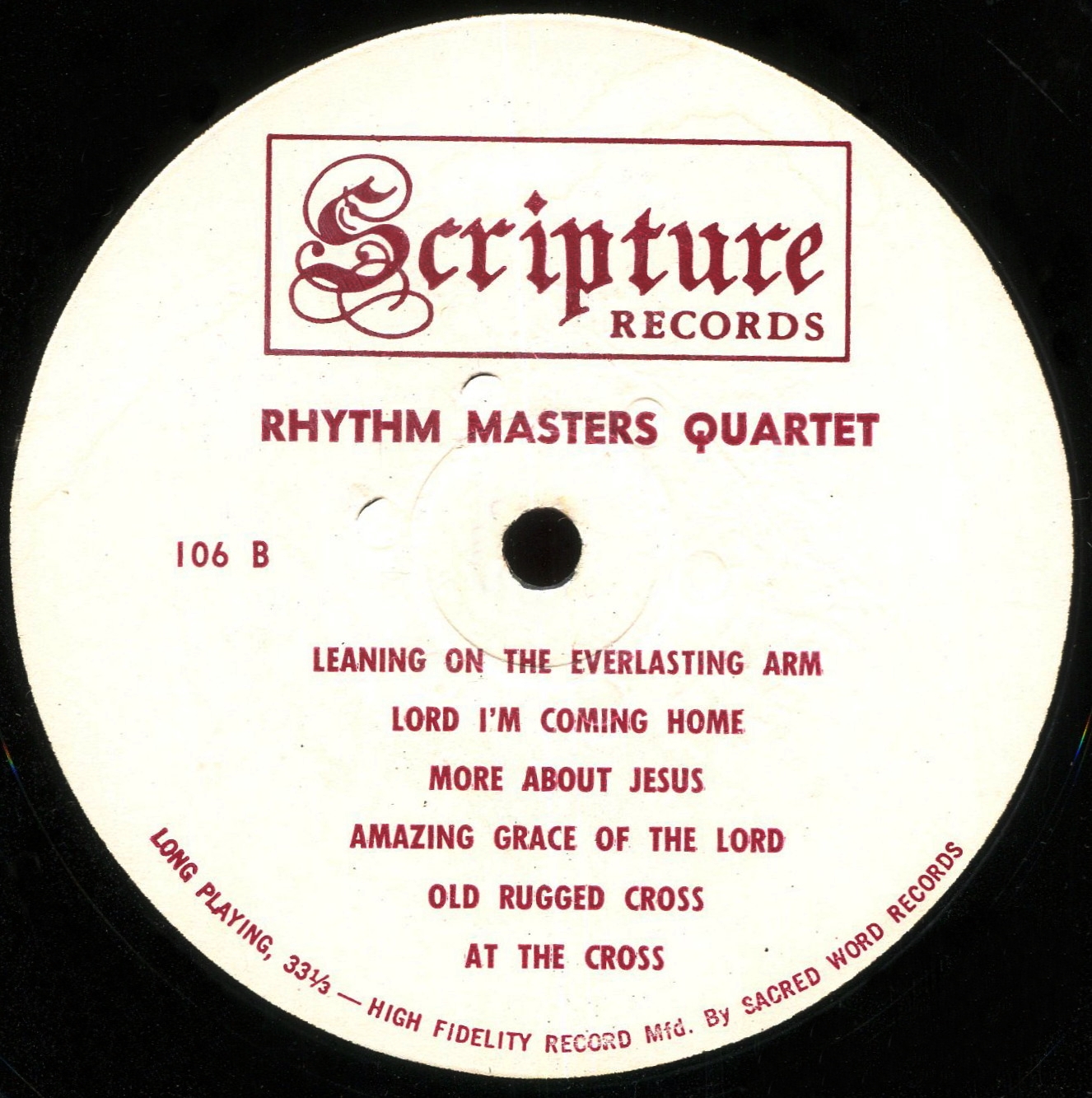
Rhythm Masters Quartet--More About Jesus (Scripture Records 106)


DOWNLOAD: More About Jesus--Rhythm Masters Quartet


Recorded in Newark NJ, but the group hails from Birmingham, Alabama.  That would explain the accents!  Expertly presented Southern Gospel, with a good number of standards--Leaning on the Everlasting Arms (or "Arm," according to the record label and jacket), At the Cross, Unclouded Day, Love Lifted Me, and other numbers which, even though they age, never grow old.  And I just have to mention what used to be a standard parody of At the Cross--namely, At the Bar.  "At the bar, At the bar, Where I had my first cigar."  Can't remember the rest.

So, these guys are at the top of their game, and the group portrait is professionally done, and... I wish I had the year for this, but Discogs isn't telling.  For some reason, the front jacket came out all wonky when I did my four-part scan, so I had to fix the white border.  The front cover art is ever so slightly off-center, but my scan had everything off by about 20 degrees.  Sometimes, the stitching function gets confused or something.  My photo software is quite old, and it hasn't been supported for quite some time, but its a great program, so I still use it.  At one point, I bought a new photo-shopping program, and it wasn't half as versatile as what I have, which was bundled in with my (now antique) Epson scanner.

Feeling like I have a fever--I'm still reacting to my second Covid shot, which happened on Friday.  I thought I was on easy street, since my initial reaction was quite mild.  Then, driving home, I felt a little woozy.  That evening, I needed aspirin and Benadryl to help me sleep.  Woke up today with the shot site hurting like (does anyone use this term anymore?) the dickens.  But nothing "concerning" so far, and I'll probably be up to playing the ol' solid state Thomas organ at church tomorrow.  I hope so.

Meanwhile, some very fine quartet singing--and I almost forgot to mention that it's a thrift gift from Diane.  Thanks, Diane!

Now to discover whether I actually have a fever or whether I simply feel like I have one.  I suspect the latter.


Lee

Saturday, March 27, 2021

#1 Pop Hits (Nashville Sound 1011; 1971?); or, Lee talks down "classic" rock


DOWNLOAD: #1 Pop Hits (Nashville Sound 1011; 1971?)

This is a first.  Never before have I posted a fake-hits LP that I can barely stand.  Boy, do I hate these selections.  I know I'm a rogue Boomer, given that I'm supposed to be in love with CCR and stuff like The Night They Drove Ole Dixie Down, but I frankly don't think most of these numbers even qualify as songs.  Rock was moving into its cellular phase about this time (probably 1971), with mind-numbing repetition of the needle-stuck-in-the-grooves type.  For instance, Never Ending Song of Love does the genius, Beethoven-level bit of going from C, down to G, then back up to C, then down to G, then back up to C, then down to G, etc.  Inane lyrics atop a single chord change are about as exciting as Bubbles in the Wine played backwards, if that much.  But the song that earns bottom-of-the-list honors would have to be the stupid Do You Know What I Mean.

Naturally, this LP had all kinds of little nicks that required file-splicing--even VinylStudio's incredible declicker feature didn't catch them all (it leaves clicks and pops alone if removing them would affect the music).  And so I was having to replay short sections of songs which are already milestones of monotony, and only my devotion to bringing you the history of fake hits--only my dedication to this proud mission could have compelled me to clean up this entire LP.  That, plus I was already about halfway done, so I figured why not suffer through the rest.  There are about four songs I like here, but Nashville Sound (Spar) sure managed to find most of my least favorite Top 40 stuff from this period.  It's almost as if... as if they planned it.  As if they looked ahead 50 years into the future and said, "Lee's going to HATE this!  Buwa-ha-haaaa!"

Memory tells me that 1971 was about the time I tuned out the Top 40 and focused on my piano lessons--rock was going places I didn't want to follow it to.  Yet, there are songs from this period that I like.  That Now Generation LP I put up (Spar, again) has a number of things I dislike, but that playlist was balanced out by stuff I didn't mind (and probably even liked, in a few instances).   So, posting that was a more positive experience.  But... these are all merely my opinions, and feel free to totally disagree.  There's no right or wrong when it comes to taste.  It's just that I've been on boards where people break out in sunspots if they discover you don't like, say, Pink Floyd or Cream (and I don't).  "But, that... that's not allowed!"  None of us signed a contract promising we would like what everyone else likes.  I never did, anyway.

My favorite thing is, "How can you not like (name of group/singer)?"  These are people who don't realize that they are not the prototype for every other human in our species.

Even Gypsies, Tramps and Thieves and Take Me Home Country Roads were like sweet relief from the fake CCR and fake Rod Stewart--they both function as songs, at least.  They're professionally written.  I realize that most rock tends toward simplicity, and that much early rock and roll (my favorite) is just three or four chords.  But the early stuff moves.  It has energy, with one chord going to another--like chords should.  CCR-style songs, during the early rock and roll era, would have had teens wondering what on earth they were listening to.  Part of the problem is the awful country-rock period which arrived in the late 1960s.  I never, ever understood the country-rock fetish that happened with rock journalists--I mean, if you love country, then listen to country.  That's always an option!  I know of no corresponding weirdness from that period--say, Downbeat critics demanding polka sets from Chick Corea or Herbie Hancock.  It would be like me saying, "This Irish group is fine, and jigs are okay, but I like the big-city blues sound of 1952. Can these folks totally switch gears for me?  Thanks."  The birth of jig-blues.

Anyway, disagree with me at will, if you wish, and give these mostly competently done fakes a chance--you may be amused, surprised, or both.  Brown Sugar (a song I like) gets a pretty good counterfeit treatment here--and, really, since I don't like most of the originals, I can't complain about any of the fakes which fall short.  I'm certain that Nashville Sound knew that I'd find this LP and that I'd feel a duty to rip it for my blog.  Somehow, all those years ago, it knew...  I don't know how, but it did.

UPDATE: I had meant to add a few points, but they got lost in the post revisions.  Never My Love is from 1967, and Spar was clearly using it as filler, probably having run out of 1971 material.  It's one of the four or so tracks that I like here, though it's not my favorite Association song.  And this LP's version of the excellent Goffin-King hit Go Away Little Girl (Spar didn't bother with a comma) is Spar's 1962 version by Fred York, originally released as a 45 on Hit Records No. 43, which (going by the YouTube posting) was pitched slightly lower.  York does a decent job, but he's no Steve Lawrence.


Lee

Friday, March 26, 2021

The Castles return to Europe (1914)


The Castles were loaded--they could have afforded weekly trips, had they wanted.  I decided to redo my 1914 James Reese Europe file from the last post--I really liked the sound of my first try, but I decided the lower end needed just a little more body.  I think I've succeeded, though it took precise EQing to prevent distortion.  This is The Castles in Europe, which was an incorrect title that, for some reason, Victor gave to Europe's Castle House Rag, at least on some copies.  So, this is The Castles in Europe, but it's really Castle House Rag.  By either name, the percussion is just as amazing.

Despite the woodwinds and brass, Europe's orchestra has (to my ears) a string band sound.  It's the harmonic texture as much as anything else--a texture that I'd describe as "busy," though polyphonic or heterophonic would be the more formal term(s).  It's the texture that happens when a large group of stringed instruments are playing en masse.  Much of the earliest jazz has that busy sound, and it was precisely that cluttered sound (which to some ears sounded like cacophony) that Paul Whiteman and Ferde Grofe smoothed out so superbly in Paul's jazzy dance sides--the "symphonic jazz" which journalists of the day hailed as a step up from the "crude" music of blacks.  Whiteman had "tamed" the music.

And I love Whiteman and Grofe, anyway, because their polite jazz is brilliant.  When it comes to the arts, I like to refrain from politicizing things.

But we're talking about James Reese Europe and his amazing ragtime/jazz band, and I think it's one of the all-time toss-ups as to whether this side, and other Reese recordings like it, were jazz or ragtime (or both).  Since ragtime seems to have been the form that carried over into jazz--the style which somehow, almost invisibly, mutated into the ODJB, King Oliver, and the New Orleans Rhythm Kings, I think the "Is it jazz?" question might be irrelevant here, if only because ragtime and jazz, at this point in the evolution of black music, were at times so close in style and feel as to be... the same thing, essentially.  And if anyone knows what on earth I just typed, please send me a polite email and explain it.  Thanks in advance.


The Castles in Europe (Castle House Rag)--Europe's Society Orchestra, 1914  (with extra bass)


Ripped by me from my eBay copy.  Flat curve--i,e., 0.0 Hz bass turnover, O.O dB treble rolloff, with 300 Hz bass turnover added, along with 60 Hz LF shelf.  Then a lot of EQing.


Lee